


Appearing in the early 2000s, SaaS (Software as a Service) is a new way of approaching software as a service. The company no longer buys a license giving it the right to use it, but subscribes to a comprehensive software service. This service generally includes, in addition to the use of the software, hosting, installation, configuration, and operational maintenance.
This mode is particularly suitable for client/server software via a web interface, since the application is then hosted on the provider’s server. With My Intranet HRIS, the HRIS software in SaaS mode, the company has a very complete online service.
The advantages of SaaS mode
The advantages of SaaS for HR software are multiple:
- the company no longer has to manage the technical part, which is completely subcontracted to the software solution provider. This allows the company to focus on its core business without spreading itself thin on the implementation and maintenance of IT tools.
- there is no more initial investment in hardware and licenses (CAPEX) since the company pays a subscription, this allows to smooth the cost over time. The total budget (total cost of ownership) is also known in advance and relatively stable, unlike a purchase of licenses where a certain number of additional services are often necessary whereas they were not necessarily planned at the start: updates, training, technical support, etc…
- HR software in SaaS mode is generally more accessible than on an intranet, this is useful in the case of companies having a fairly nomadic workforce.
- the implementation time is reduced since it is the job of the software provider in SaaS mode, and therefore they master this task perfectly. For example, the installation and configuration of My Intranet HRIS only require a few hours.
- the company is much freer to switch from one service to another if a solution does not suit it since it is no longer blocked by the necessary return on investment of a software license purchase.
All these points come in addition to the numerous advantages of the HRIS.
Performance and Service Level
Because HR management cannot wait, My Intranet HRIS offers maximum availability and ultra-responsive support to support your teams.
Availability (SLA)
Your data accessible 24/7 thanks to a Tier 3 high availability infrastructure.
Support Responsiveness
Average response time of our technical team based in France.
Deployment
Up to 100 users, your environment is configured and ready to use in less than a week.
Secure Data
Sovereign hosting in France, daily backups and GDPR compliance.
Key modules of a SaaS HRIS
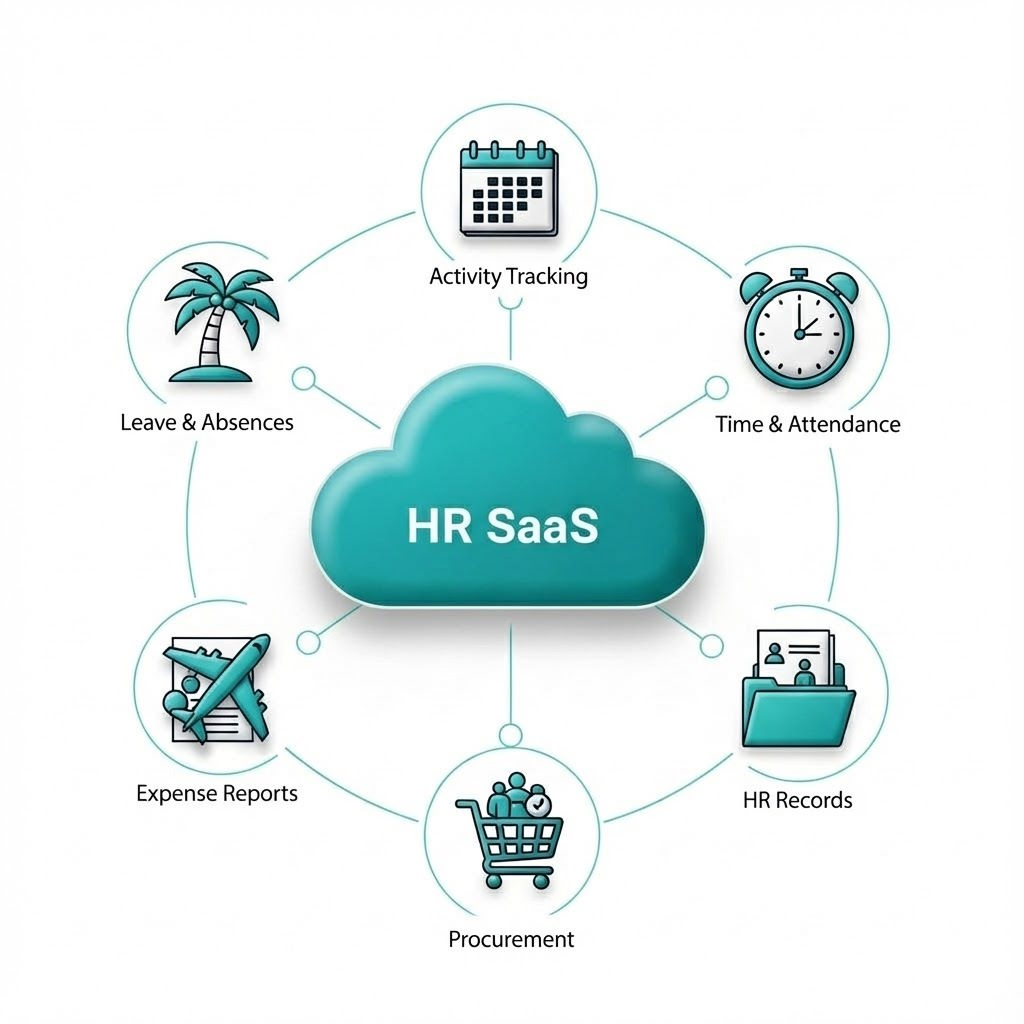
My Intranet HRIS integrates 7 modules to digitize your processes:
- Leave and absence management ;
- Working time tracking ;
- Planning and activity management ;
- Internal directory ;
- Employee HR file ;
- Purchase management ;
- Expense report management.
What are the points to watch out for?
Regarding disadvantages, it is quite limited:
- the company no longer has total and internal control of its IT tools.
- in theory, data confidentiality and access security may seem more at risk by using an external service. In practice, for many companies for whom it is not the core business, recourse to a specialized service provider is the assurance of having a good level of security and confidentiality. At My Intranet HRIS, we have put in place numerous mechanisms to guarantee the security of your data: granularity of access levels, frequent backups and two-factor authentication.
The SaaS HRIS: a performance lever for all companies
SaaS is extremely widespread in HR solutions. Indeed, HR processes are increasingly paperless. The gain for the company in terms of time and therefore money is huge and immediate since there is no longer a heavy initial investment. All this justifies the use of an HRIS.
Last advantage of SaaS, it makes human resources management software accessible to all companies, whatever their size, as the cost of access to the service depends on the number of users. Moreover, the technical part being supported by the provider, any company, regardless of the extent of its IT department, can easily use the solution. Thus, HRIS software, formerly reserved for large companies, is now open to all. This allows addressing the problems identified during the mapping of HR processes.
WHO IS IT FOR? SaaS HR Software
SMEs / MID-CAPS
- Simplified Management: Automation of admin tasks.
- Time Saving: Focus on HR development.
- Controlled Cost: Scalable solution with no heavy investment.
STARTUPS & TECH
- Scalability: Support for rapid growth.
- Agility: Flexible and mobile HR processes.
- Employer Branding: Modern and collaborative tools.
LARGE GROUPS
- Unified Vision: Multi-site/subsidiary HR management.
- Compliance: Legal updates.
- Optimization: Advanced reporting & decision support.
Comparison between SaaS and On-Premise modes
| Criteria | SaaS HRIS | On-premise HRIS |
|---|---|---|
| Installation | Hosted on the provider’s servers | Deployment on company servers |
| Initial costs | Reduced | High (license purchase) |
| Long-term costs | Recurring subscription fees | Initial costs plus maintenance costs |
| Maintenance | Managed by the provider | At the company’s expense |
| Updates | Automatic and frequent | Require intervention |
| Accessibility | From anywhere via Internet | Limited to the company network |
| Customization | Linked to solution parameters | More flexible and adaptable |
| Data control | Dependence on provider | Total internal control |
| Security | Managed by the publisher | Under company control |
| Internet dependency | Requires connection | Can work offline |
| Scalability | Easy to adapt | May require investments |
| Internal resources required | Minimal | Significant (IT, maintenance) |
The 15 key criteria for choosing a SaaS HRIS
Choice criteria vary from one company to another depending on priorities and constraints, particularly at the HR department level. Nevertheless, here are some criteria commonly found when choosing a SaaS HRIS:
- Features: Ensure that the software covers all your company’s HR needs (leave, expense reports, working time, purchases, etc.).
- Ease of use: The interface must be intuitive and user-friendly to encourage adoption by users.
- Flexibility and customization: The system must be able to adapt to your HR processes and evolve with your company.
- Data security and confidentiality: Check sensitive data protection measures and compliance with regulations (GDPR, etc.).
- Integration: Ensure that the HR management software integrates easily with your other existing tools and systems, especially your payroll software. My Intranet HRIS data integrates seamlessly into ADP, Cegid, Sage, Silae and many other payroll software on the market.
- Support and maintenance: Evaluate the quality of customer service, the frequency of updates and the availability of technical assistance.
- Mobility: Check accessibility from different devices with a responsive interface.
- Cost: Compare the rates of different solutions taking into account the total cost of ownership (subscription, training, support, etc.).
- Scalability: The SaaS software must be able to support your company’s growth without compromising performance.
- References and reputation: Find out about the experience of other companies similar to yours with the provider and the solution.
- Legal compliance: Ensure that the SaaS solution is regularly updated to remain in compliance with legislative and regulatory developments.
- Reporting and analytics: Evaluate the system’s capabilities in terms of report generation and HR data analysis.
- Access and rights management: Check that the system allows fine-grained management of access rights according to roles and responsibilities.
- Availability and performance: Ensure that the provider guarantees a high level of service with an optimal availability rate (with an SLA).
- Hosting: Opt for a service installed with an ISO 27001 certified host with servers in France or Europe.
🎯 Which HRIS mode is right for you?
Answer 8 questions to find out if SaaS or On-Premise mode better fits your needs
With SaaS, personnel management software becomes a consumable service just like any other service. Its cost is truly adapted to the need and therefore the return on investment is optimized.
